
Constructing a Cryptic #6: My Process

Nobody asked for this post, but I do hear from a number of newer constructors that they have writer’s block working on their first cryptic. Totally understandable! I know clue writing even for a vanilla crossword is daunting to some folks, but at least with vanilla, you can be straightforward some of the time and not have to think carefully about every single clue. (And you can also look at clues others have done for inspiration.) With a cryptic, on the other hand, you’re striving for wit and deception with every single clue. Even if you’ve won the contest a time or two, coming up with 30 clues, many of which are for words that weren’t expressly chosen for their wordplay potential, is not easy.

I’m sharing my process here as the latest in my series on cryptic construction in case it’s helpful to others. Not everything I do will necessarily work for you, but I hope it helps somebody!

Step 1: Seeding and building the grid
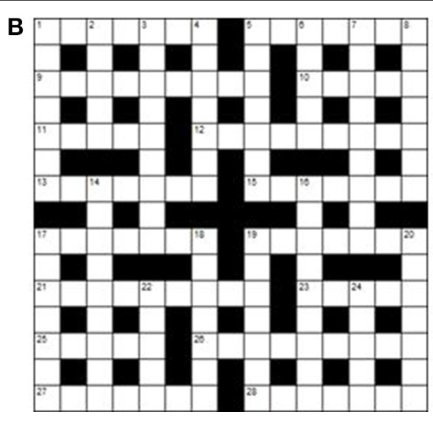
I covered this bit in Post 2 of the series, but to reiterate: I always have a Google doc going with words and clues that I pick from for the contest or that I want to build a puzzle around. I usually pick no more than two seeds from this document. I don’t bother with grid design at all, because the Brits have pretty much already generated every possible legal permutation of 15×15 grid. I pick a grid from a giant book of Guardian puzzles I have, from a handful of screenshots I’ve saved from Times of London or Guardian puzzles online, or I do a Google image search for “Times cryptic crossword.” Then I put my seeds in, watching out for placement of letters in spots that are likely to limit fill potential. (For example, if a seed entry contains the letter I, I avoid placing the entry such that the I will be at the end of a crossing word of longer than 6 or so letters.)

I then fill the rest of the puzzle, taking care to look for fill that has high wordplay potential as I go (see Post 3 of the series for more on that).

Step 2: Keep the momentum
Although I never clue an entire puzzle in one sitting, the period when I fill the puzzle is the most fertile, in my experience, for coming up with clues. I think this is because I’m already thinking about clue potential at every step of filling the grid. If I’ve noticed a particularly interesting bit of wordplay, I’ll try to come up with a clue right then and there. If I can’t, I leave myself a note in the clue space, with lots of brackets or asterisks so I don’t mistake it for my having actually completed the clue. Example: For the entry APRICOT, I might leave myself the note ****APRIL curtailment plus COT.

Step 3 (and 4, and 5…)
I typically try to do 3 or 4 clues per puzzle, per sitting. If you do this every day, you’ll finish cluing your puzzle in 7-10 days. Sounds manageable when you put it that way, right?

For my first pass after I’ve filled the grid, I look especially for entries that have homophone potential. As a solver, I think homophones are the most under-used clue type: They’re often wonderfully funny to think through! I don’t want to overuse, naturally, but up to two in a puzzle is fine IMO, and if I’m not specifically looking out for them, I tend to gravitate naturally more to charades and containers.

I also make sure that each sitting includes at least one clue for a word that I expect to present more difficulty than the others (usually because it’s longer, but can also be because it has a lot of Scrabbly letters). If I just do the easy ones first, the process of cluing will get harder and harder as I go, and it’s harder to bring myself to finish.

What I’m not doing at this stage: Worrying about whether I am overusing any particular clue type or indicator word, with the exception of using whole-entry anagrams only as a last resort. This is especially true of longer entries — when you anagram an entire entry of 9 or more letters, generally the resulting anagrammed phrase isn’t going to be something that lends to a natural surface reading.

Last phase: Self-editing
Not gonna lie, this is my least favorite part of making any puzzle! Yes, if you have an editor you can rely on them to spot things you could’ve done better, but you will endear yourself to said editor if you make their job a little easier by not sending them your very first draft.

I always wait at least 3 days after I write the last clue for a puzzle before looking at it again. Then I look carefully at each clue: Is the surface sense as strong as I thought it was when I wrote it originally? If the clue has an indicator word, is there another indicator that would work better with the surface? If I anagrammed my way out of a difficult entry, is there other wordplay fodder I may have missed?

I don’t typically bother with these steps any more, but I did when I was less experienced, and I think they’re great for newer constructors:
1. Tally up your clue types to see whether you have overused one or more clue types. I used to do this with tick marks. I think it may have been Nate who suggested the wonderful idea of color-coding, if you have a good-sized rainbow of highlighters available to you (or a version of Acrobat that allows you to apply comments): Highlight anagram clues in green, homophones in pink, charades in yellow, etc. These are obviously arbitrary color choices and you can assign whatever color suits you, but whatever you choose, color-coding, as long as you are not color-blind, makes it immediately apparent if you’re leaning too heavily on a clue type.
2. Make a PDF of your puzzle, then search for common indicator words such as “first,” “head,” and whatever your personal favorite anagram indicators are. If you have used any indicator word more than once, now is the time to go back and replace the dupe(s) with something else.

You may also wish to have a friend test solve, but I think if you’ve done all this and you’re working with an experienced editor, the above is more than enough to feel good packing the puzzle off for editing. (Speaking from experience from the editing side, you may introduce an imbalance of clue types during the editing process while trying to fix other things — test solving is great for pointing that out!)
Constructing a Cryptic #5: Thoughts from Nate the Great

This is the last (for now) in my series of posts crystallizing my thoughts on cryptic construction so that new constructors can learn from it. You’ll notice I’m putting this info up here on Tough as Nails, not anywhere affiliated with AVCX: That’s because these are my personal thoughts, not to be taken as editorial standards, and not everything I do will apply to every constructor. YMMV.

Well, except that this post isn’t about what I think, it’s my paraphrasing what the wonderful Nate Cardin, cryptic constructor and now editor, thinks.

I showed my initial thoughts on cryptic puzzlemaking — the material from which the previous posts in this series was built — to Nate. Nate is one of the reasons I’m so glad to evangelize for cryptics; I had a smidge more experience than he did when he got started, and I was able to give him a bit of guidance which he has taken and run with and then some. (If you don’t already have a subscription to The Browser, where he and I are both regulars, what are you waiting for?)

Anyway, I’m paraphrasing some of the responses he had and I want to specifically credit them to him because hell, I want to try some of these techniques now!

Nate’s clue-writing tips:

  • When writing a clue, figure out the definition half first, then build surface sense and clue around that with the wordplay. (Stella note: Interesting! I do not always start with the definition half when clue writing, but I can see how that would be easier much of the time. I’m going to try this!)
  • Make the straight (definition) end of clue fair to the solver, even if it is a bit cheeky or tricky. You can use a larger group to define an example in cryptics in a way that you can’t in vanilla crosswords, but don’t be so vague that the solver can’t feel sure when they have the right answer.
  • Vary wordplay in your clues, but limit how many hidden words, double definitions, and homophones you use (1-2 each max per puzzle). (Stella note: These clue types tend to be noticed by solvers when they’re used in excess, and although I’ve seen some exceptions, this is a good rule of thumb for how much you can get away with with most editors.)
  • Anagramming long entries is tricky. If you anagram an entire entry of 10 or more letters, it’s likely to produce a less-than-natural surface. So, if you have a puzzle with multiple long entries, don’t fully anagram all of them even though that can seem at first like the easiest way to handle them. Can you anagram part of the entry and use a different wordplay technique with the other part(s)?
  • Strive for an average clue length of 6 words, which is what the greats Cox and Rathvon do. Very long clues can be a slog for solvers to figure out. This is not to say that there shouldn’t be variety in clue length (note from Stella: in fact, an editor once told me to “let my clues breathe,” that they on average were too SHORT! so…YMMV), just that you shouldn’t be writing a novel every time.

Constructing a Cryptic #4: Clue Writing

This is part 4 in a series crystallizing my thoughts on cryptic construction so that new constructors can learn from it. You’ll notice I’m putting this info up here on Tough as Nails, not anywhere affiliated with AVCX: That’s because these are my personal thoughts, not to be taken as editorial standards, and not everything I do will apply to every constructor. YMMV.

In a way, getting good at clue writing comes before any of the steps I’ve mentioned previously, although I have posted about them in the order that I have since that is the order in which I tackle things when actually making a puzzle. But of course you can always practice writing cryptic clues well before you make your first puzzle — in fact, that’s why #crypticclueaday exists. (I started it as a challenge to myself to write a cryptic clue every day for the month of August 2019, and I found that I didn’t want to stop!)

Here’s how I think about clue writing when I’m making a whole puzzle, as against my daily clues:

I generally do not clue a whole puzzle in one sitting. Cryptic clue inspiration on command is not something I have (which is why I’m glad I run #crypticcluecontest instead of participating in it!). Instead, I’ll typically have three to four puzzles in various stages of completion in the hopper at any given time, and I might do a cluing session in which I write five or six clues each for two or three different puzzles at once. My subconscious often works on the more intractable clues between sessions and sometimes I’ll be able to come up with something right away on a second sitting that was eluding me the first time.

Mistakes I have made and learned from:

  • Using a clue in which any part of the wordplay has the same etymology as the definition. This is varying levels of no-no: Some editors won’t let you do it at all, and some will allow it if there’s been a great deal of drift in meaning between two words even though their root is the same. I now use etymoline.com pretty extensively for checks – it has a lot more information on word origins than Merriam-Webster.com, my definition resource of choice.
    • IMPORTANT! “Same etymology” is not the same as “same meaning”! For example, let’s say you wanted to clue CONTRACT as a combination of CON in its “scam” sense and TRACT in its “parcel of land” sense. If you look at the etymologies, the CON in both CONTRACT and CON(fidence, since CON ARTIST is short for CONFIDENCE ARTIST) comes from the same Latin root of com (“with”), and TRACT as a standalone word comes from the same Latin root of trahere as the -TRACT in CONTRACT. You might not guess that just from looking at the word CONTRACT.
    • A rule of thumb of mine: Always do an etymology search if you are breaking up a word into components that match up to individual syllables. But even if you’re breaking up on other lines, it never hurts to check.
  • Not being careful enough about extraneous words. “It makes the surface sense more natural” is not sufficient justification to add a connector word. The cryptic reading of the wordplay must literally produce the answer word. 
    • Some extraneous words, such as “with” or “and” in the context of a charades clue, are okay because they don’t change the cryptic reading of the clue in any way. But if the added word would have to be ignored to produce a correct answer, it shouldn’t be there. (I will get to a post with examples of good and bad ways to do this eventually.)
    • Some connector words work in only one direction, such as “of” and “from.” You get [defined word] from [wordplay fodder], not the other way around, so your clue should not be of the pattern [wordplay fodder] from [defined word], as an example.
  • Trying to talk myself into the naturalness of a surface sense. If even as I’m writing the clue, I think, “this is kinda clunky,” time to start over. From Nate Cardin: “The best advice you gave me when I was starting up was to step away from clues for multiple days and then come back to see if the surface sense still made sense to me. If it doesn’t, edit or change the clue.” Yup, I still do this – see above re: not cluing a whole puzzle in one sitting.

Next time: Some excellent cluing advice from Nate himself!

Constructing a Cryptic #3: Grid filling

This is part 3 in my series crystallizing my thoughts on cryptic construction so that new constructors can learn from it. You’ll notice I’m putting this info up here on Tough as Nails, not anywhere affiliated with AVCX: That’s because these are my personal thoughts, not to be taken as editorial standards, and not everything I do will apply to every constructor. YMMV.

If you’re just coming in, check out my earlier posts on making and seeding a cryptic grid.

Once you have your seeds in place, it’s time to fill the rest of the grid. When I do this, I evaluate my options for cluing potential as I fill:

  • Does a word jump out at me as breaking up nicely into two or more words for charades, or one word inside another for container/contents?
  • I’ll run options through the Internet Anagram Server to see whether any interesting anagrams emerge.
  • I avoid compound words, unless I can immediately see a Spoonerism or a way to break up the word in a way other than the break between the two words that form the compound. Otherwise I find that compound words are often a pain in the ass to clue.
  • Words and phrases with lots of common letters and/or a fairly high vowel-to-consonant ratio have more anagram potential than, say, something like BACK SQUAT, as much as I love back squats.

But the major point here is that I’m thinking about clue potential, not the inherent interestingness of the entry itself, with every single slot as I am filling it, well before I have actually started writing the clues. It is quite a bit easier to tear out and redo a corner with a cryptic grid than with a vanilla grid, but it’s quite painful to do so after you’ve come up with good clues for answers that cross a word you decide you need to get rid of.

Nate Cardin put it this way: vanilla crossword constructors always get asked the question, “What comes first, the grid or the clues?” In that context, the question generates an eye roll because anyone who’s tried making a vanilla crossword knows the grid is first. But in a cryptic, the clues, at least a few of them, are the starting point. And they’re something you focus on throughout the development of the puzzle, not just after the grid is done, because they’re the heart of the solver’s experience.

I also work my way from the longest entries to the shortest ones when filling the grid, since long entries tend to be harder to clue than shorter ones. It’s more important that I have several options to choose from in the slots of 8+ letters in length than in the 4s, 5s, and 6s.

Constructing a Cryptic #2: Seeding the Grid

Now that I’ve been part of the AVCX cryptic editing team for a few months, my mind is always on looking out for people who have potential to make cryptics. There’s a lot less material out there if you’re trying to figure out how to construct an American-style cryptic than for vanilla crosswords. I think back to my own first attempts at cryptic-making and they were pretty cringe-worthy. (I would like to publicly apologize to Joon Pahk and Patti Varol in particular for what I sent them back in the day.)

Here’s the second in a series of posts to crystallize my thoughts on cryptic construction so that new constructors can learn from my mistakes. You’ll notice I’m putting this info up here on Tough as Nails, not anywhere affiliated with AVCX: That’s because these are my personal thoughts, not to be taken as editorial standards, and not everything I do will apply to every constructor. YMMV.

Picking your seeds

Filling a cryptic is a very different experience from filling a vanilla crossword. In a vanilla puzzle, the solver’s joy comes both from figuring out clever clues and from seeing lively entries, where “lively” often means “I’ve never seen that in a puzzle before, yay!” You might want to introduce the solver to your favorite opera, fashion designer, drag queen…well, I might. But you know what I mean. And as a solver of (so many!) vanilla crosswords, I enjoy learning a new name or fact from a puzzle. In fact, plenty of times I’ve read a book or watched a TV show because I learned about it from a crossword, looked it up, and decided I had to know more.

The cryptic solver’s experience is different. An unfamiliar entry in a vanilla crossword has about twice as many crossings as that same entry in a cryptic to help a solver get there, and the cryptic solver needs to have that confirmatory “Yes! This is the right answer!” moment at the end, which is not going to happen if she’s never heard of that answer before. 

On the other hand, the great joy of a cryptic solver’s experience is figuring out tricky wordplay in the clue. An answer word that someone would consider not so interesting in, say, a themeless can be great in a cryptic if it’s clued right. (As evidence, check out this #crypticcluecontest from 2020, in which the kinda meh word COMPETENT generated some fun clues.)

All this is to say: Your seed entries, of which I usually start with two to four, should be chosen based on already having a good clue in mind, more so than whether the entry itself is extra lively. That being said, if you have a lively entry that you can also clue well, have at it! Just try to choose entries for which “lively” does not equal “fact that is likely to be new to a decent number of solvers.” As noted in the AVCX audition process, entries I’ve seen that fill this bill include TRASH PANDAS (Francis), LEATHER BAR (Nate), and VIBRATOR (also Nate).

I keep a running Google doc of words I’ve thought of a good clue for, separated by whether I think they’re #crypticclueaday fodder or worthy of seeding a puzzle I want to get paid for. That way I’m never short of seeds!

Constructing a Cryptic: Grid Design

Now that I’ve been part of the AVCX cryptic editing team for a few months, my mind is always on looking out for people who have potential to make cryptics. There’s a lot less material out there if you’re trying to figure out how to construct an American-style cryptic than for vanilla crosswords. I think back to my own first attempts at cryptic-making and they were pretty cringe-worthy. (I would like to publicly apologize to Joon Pahk and Patti Varol in particular for what I sent them back in the day.)

So I’m using this series of posts to crystallize my thoughts on cryptic construction so that new constructors can learn from it. You’ll notice I’m putting this info up here on Tough as Nails, not anywhere affiliated with AVCX: That’s because these are my personal thoughts, not to be taken as editorial standards, and not everything I do will apply to every constructor. YMMV.

Designing the grid

YMMV right here! Grid design in vanilla crosswords has never been my strong point, and my MO in cryptics is always just to borrow something that someone else has already done. I simply do a Google image search for “cryptic crossword” and pick a grid that has entries of the correct length for my seed entries. Some principles for beginners when grid-picking:

  • Carefully look over the grid to make sure that it follows the below standard conventions, which apply to most places you’d be submitting your puzzle. Just because you find a grid on the Internet doesn’t mean it follows the rules! Ask me how I know.
    • No two “unchecked” letters (i.e., letters that are part of only one word) should be adjacent to each other
    • At least half the letters in each word are checked
    • Three-letter entries should be avoided; some markets disallow them altogether, others allow them in very limited quantities
  • Longer entries are much harder to clue than shorter ones. If you don’t already have a clue in mind for a long entry, a more manageable first grid would be one that doesn’t have entries longer than 10 letters. 

This is a grid that I have used quite a bit that works great for beginners. It’s nothing but 5s, 7s, and 9s, lengths that generally produce entries that are manageable to find good wordplay for.