Constructing a Cryptic: Grid Design

Now that I’ve been part of the AVCX cryptic editing team for a few months, my mind is always on looking out for people who have potential to make cryptics. There’s a lot less material out there if you’re trying to figure out how to construct an American-style cryptic than for vanilla crosswords. I think back to my own first attempts at cryptic-making and they were pretty cringe-worthy. (I would like to publicly apologize to Joon Pahk and Patti Varol in particular for what I sent them back in the day.)

So I’m using this series of posts to crystallize my thoughts on cryptic construction so that new constructors can learn from it. You’ll notice I’m putting this info up here on Tough as Nails, not anywhere affiliated with AVCX: That’s because these are my personal thoughts, not to be taken as editorial standards, and not everything I do will apply to every constructor. YMMV.

Designing the grid

YMMV right here! Grid design in vanilla crosswords has never been my strong point, and my MO in cryptics is always just to borrow something that someone else has already done. I simply do a Google image search for “cryptic crossword” and pick a grid that has entries of the correct length for my seed entries. Some principles for beginners when grid-picking:

  • Carefully look over the grid to make sure that it follows the below standard conventions, which apply to most places you’d be submitting your puzzle. Just because you find a grid on the Internet doesn’t mean it follows the rules! Ask me how I know.
    • No two “unchecked” letters (i.e., letters that are part of only one word) should be adjacent to each other
    • At least half the letters in each word are checked
    • Three-letter entries should be avoided; some markets disallow them altogether, others allow them in very limited quantities
  • Longer entries are much harder to clue than shorter ones. If you don’t already have a clue in mind for a long entry, a more manageable first grid would be one that doesn’t have entries longer than 10 letters. 

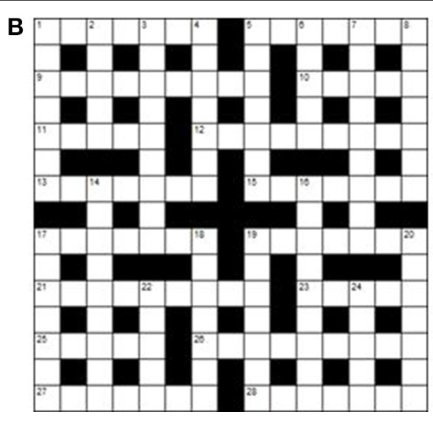
This is a grid that I have used quite a bit that works great for beginners. It’s nothing but 5s, 7s, and 9s, lengths that generally produce entries that are manageable to find good wordplay for.

Announcing the Oneth-of-the-Month Mini Cryptic!

As many of you know, I’m an evangelist for cryptic crosswords. I make them for The Browser and The New Yorker and I’ll soon be editing them for the AVCXpansion. And of course there’s #crypticclueaday and the #crypticcluecontest on Twitter.

I’ve been really gratified by how many people have told me that the daily clues on Twitter have helped them understand cryptics a little better–that solving an entire puzzle was too intimidating, but one clue at a time was totally doable, especially with explanations come Friday.

I’ve been thinking for a while that just as mini (5×5) puzzles have brought lots of solvers into the fold in the standard-crossword world, the cryptic world desperately needs minis as a gateway drug, er, way to get more Americans to try this wonderful puzzle type. It is likely that at least one market will do this in the not-too-distant future, but I’m getting impatient. So here’s one from me, with the promise that I’ll do at least one a month this year!

If you’ve never solved a cryptic before, start with my Decrypting the Cryptic posts, which explain the various clue types:

If you’ve never solved a cryptic before and you give this one a try, please do let me know in the comments. If the evangelism works, I want to know about it! There are only six words in this puzzle, so YOU CAN DO IT!

Mini Cryptic #1 – Across Lite

Cryptic media circus!!!!

Can’t believe I forgot to post it here! For those who don’t follow me on social media, I had a really big cryptic Sunday: three puzzles published on one day, two of them cryptic debuts. Solve ’em here:

I also did an interview with The Browser in which I discuss cryptics and look swole (free to watch).

A cryptic for you!

Once Nate became the first person to put a cryptic puzzle on my site I thought, okay, okay, it’s finally time to do one on the site also! As a few of you have requested, it’s a 13×13 puzzle, so a little smaller and easier to deal with than most published puzzles.

Cryptics won’t be a regular feature on the blog; given that I’m already putting out free themelesses and a ton of cryptic clues on the regular, I’d like to get paid for making full puzzles!

Although it may seem that a cryptic must be easy to construct given the small number of words in the grid and that only about half of the letters have to be checked, to me they’re quite a bit harder. You know the stereotypical question about “What do you do first, write the clues or come up with the answers?” that people ask about standard American crosswords, and that it indicates a complete lack of understanding of the construction process? It’s not a silly question at all about cryptics. You’ve got to be thinking at every step of the word-choice process whether that word lends itself to good wordplay in a clue. (I learned this one the hard way, when I filled my first few cryptics with words I found very interesting, as I would for a themeless, but then realized I couldn’t break them up into bits for cluing, which led to some very tortured anagrams.)

End aside; here’s the puzzle! I’m on vacation, so I won’t be checking the comments to this page much, but please do @me on Twitter if you have something to say.

Oh yeah…I realized I didn’t write any explanations for this one (the solution grid is just the solution grid). Will try to get to that when I return from my vacation, which is very much needed.

Not-Tough as Nails Cryptic #1 – Across Lite

Guest qryptic from Nate Cardin!

Meet guest qryptic constructor Nate Cardin and his absurdly cute pupper, Eero!

A few of you have asked me for an easy cryptic to help you practice the solving skills you’ve gotten through my Decrypting the Cryptic series or #crypticclueaday. And I keep saying “no time for that, sorry…”

Simultaneously, the utterly delightful Nate Cardin has become addicted to cryptic construction and is ready for his puzzles to come out in the world. Well, if that isn’t a happy confluence of interests, I don’t know what is.

So I’m thrilled to bring you one of Nate’s first completed puzzles! Here’s a little about him: Nate is a high school chemistry teacher in Los Angeles, where he lives with his husband and his puppy, Eero.  He is very much into word games, Survivor, Cinnamon Toast Crunch, and caring.  Black lives (and experiences, thoughts, contributions, and so much more) very much matter to him. [Those are Nate’s words, but let’s not forget that he’s also the founder and co-editor of Queer Qrosswords, a kickass puzzle diversity initiative that publishes LGBTQ+ constructors. I binge-solved the entirety of Queer Qrosswords 2 on a flight from NYC to Los Angeles last year, and I highly recommend it!]

And here’s a note from Nate (that’s basically a cryptic clue waiting to be written, amirite?): I’m so proud to debut my very first cryptic crossword on Stella’s site, since her #crypticclueaday tweets inspired me to delve into cryptics so earnestly. For this and other cryptics I’ve been working on over the past few months, I’m indebted to the time, advice, wisdom, and feedback of folks like Stella, Andrew Ries, Neville Fogarty, Steve Mossberg, and Joshua Kosman. I am made better by the crossword community and I hope I can give back even a fraction of what they (and you all) have given to me. I hope you enjoy the solve – let me know if you particularly enjoyed (or hated!) any of the clues. You can find me on Twitter @naytnaytnayt.

I think you’re gonna love it: Those of you who’ve already seen Nate’s clues on Twitter know that his take on cryptics is FRESH AF. ENJOY!!!!

Nate Cardin for Tough as Nails Qryptic – Across Lite

Decrypting the Cryptic #15: &lit.

Welcome to Decrypting the Cryptic #15! In this series, we’ll be taking apart common cluing conventions used in American cryptic crosswords to build your confidence in solving a puzzle variety that can be, as its name implies, especially challenging. 

This will be the last Decrypting the Cryptic post for a while. Not because I’m tired of writing them, but because I’ve now explained to you almost all of the rules and conventions that I know.

I’ve been waiting and waiting to tell you guys about &lit. clues. Why? Because they’re the most elusive of creatures, the hardest for a constructor to come up with. I have a feeling that one does not sit down and write an &lit. clue; rather, an &lit. clue comes to visit you, like a bird stopping by your bird feeder IF you’ve chased all the squirrels away AND you’ve filled the feeder with the very finest suet AND the weather is perfect AND the bird damn well pleases. I was hoping that by the time I was ready to write a post about them, I’d have come up with one.

…I haven’t. So you’ll all have to be content with examples by other people.

What, then, is this mythical beast? “&lit.” is short for “and literally.” What that means in the context of cryptics is that unlike all other clues, which can be broken into a straight definition portion and a wordplay portion, &lit. clues can be read in their entirety as both at the same time. Often, but not always, an exclamation point at the end of the clue is placed to indicate its &lit.-ness.

Here’s what that looks like:

Example #1: Schmear spread a bit at a time! (5,6) (Clue credit: Joshua Kosman and Henri Picciotto, Out of Left Field #5, by subscription only.)

The answer is CREAM CHEESE, which you could say literally is a “schmear spread a bit at a time.” So, the entire clue serves as a way of literally describing the answer. But the clue can also be read as wordplay: SCHMEAR is a letter bank for the phrase CREAM CHEESE; that is, all the letters for CREAM CHEESE are found in the word SCHMEAR. That means that if you “spread” the letters in SCHMEAR “a bit at a time,” you get the phrase CREAM CHEESE.

Note that in this clue, the exclamation point is indeed an indicator for an &lit. clue; “Schmear spread a bit at a time” is just not a phrase one would be expected to shout with emphasis in normal parlance. However, exclamation points are not always indicators for &lit.; if the surface sense of a normal two-part cryptic clue would work with an exclamation point, the constructor may add one.

Let’s try one more &lit. example:

Example #2: I’m a leader of Muslims! (4) (Clue credit: Guardian puzzle #23892 by Rufus; heard through Crossword Unclued)

This brilliantly simple clue leads to the answer IMAM. An IMAM could tell you, literally, “I’m a leader of Muslims” by way of definition. And if you take the first two words in the clue — I’M A — and add the first letter of the word “Muslims” (“leader of Muslims,” get it?), you get IMAM.

Hope you enjoyed these uncommon &lit. sightings, and if you’re a budding cryptic constructor, I wish you an &lit. of your own in the not-too-distant future. Hell, I wish one on myself! Don’t forget to check out #crypticclueaday on Twitter. I post a new clue each day using that hashtag (other constructors have been adding their own as well), and every week on #explanationfriday I give the solutions and a brief explanation of how to derive them. These clues are a great way to hone your cryptic solving skills and build your confidence up to solving a full puzzle.

Decrypting the Cryptic #14: The Cryptic Alphabet

Welcome to Decrypting the Cryptic #14! In this series, we’ll be taking apart common cluing conventions used in American cryptic crosswords to build your confidence in solving a puzzle variety that can be, as its name implies, especially challenging. 

I’m running out of actual rules to explain to you guys — in fact, the only big one I can think of that I haven’t done yet is the &lit. clue, which is a beautiful thing but difficult to achieve for a constructor and therefore not very common. So, we’ll save that one for next week. Instead, we’ll look at something constructors need to do a lot, which is to indicate a single letter of the alphabet in some way. That letter might need to be added to a word, be dropped from a word, play in a game of charades — but no matter what, it’s boring and not very cryptic simply to give the solver that letter. So here are some ways that we do that.

  • If a word has a common single-letter abbreviation, then the whole word might be used in the wordplay to clue that letter. For example, on your bathroom faucet, the hot and cold taps may be marked “H” and “C”; thus, “hot” and “cold” are often used to indicate those letters in cryptic wordplay. Other examples include:
    • “Win” and “loss” for W and L
    • “Runs,” “hits,” or “errors” for R, H, or E
    • “Left” and “right” for L and R
    • “True” or “false” for T or F
    • “Yes” or “no” for Y or N
    • “Male” or “female” for M or F
  • The NATO phonetic alphabet: “Charlie” for C, “tango” for T, etc.
  • Elemental symbols (not limited to single-letter symbols, of course): “oxygen” for O, “potassium” for K, etc.
  • Other common math and science abbreviations and symbols
    • “Speed of light” for C
    • “Time” for T
    • “Force,” “mass” and “acceleration” for F, M, and A
  • “Nothing” and its synonyms (“zero,” “nil,” etc.) for O, since O looks like a zero
    • “Love” is also frequently used in this way, since love is zero in tennis!
  • Letter grades: “good” for B, “average” for C, “poor” for D, etc.
  • Abbreviations for units of measurement
    • “Second” for S
    • “Meter” for M
    • “Gram” for G
  • “Fork” for Y (get it? Ys are shaped like forks!)
  • Roman numerals: “ten” for X, “five” for V, etc.

Now that I’ve thrown a big, but not comprehensive, laundry list at you, here are a couple of examples to practice:

Example #1: Full minimum stream (4)

The answer is FLOW, or “stream” (either in the verb or the noun sense). A “minimum” is a “low,” so the single letter being clued here is F — which is “full” on your gas tank.

Example #2: Opera article comes after terrible cost (5)

The “opera” being clued here is TOSCA. “Terrible cost” leads you to anagram the letters in the word COST to get TOSC. What “comes after” that is the last letter in the word, A, which is an “article,” as in an indefinite article in the grammatical sense. (Thus, “article” can also be used to clue the letter strings AN or THE, just not this time.)

Hope you enjoyed our exploration of the cryptic alphabet, and don’t forget to check out #crypticclueaday on Twitter! I post a new clue each day using that hashtag (other constructors have been adding their own as well), and every week on #explanationfriday I give the solutions and a brief explanation of how to derive them. These clues are a great way to hone your cryptic solving skills and build your confidence up to solving a full puzzle.